




PROTECTING INDIA’S WILD AND ENDEMIC THREATENED MEDICINAL PLANTS
By Manoj Sarkar
Introduction
A group of plants, which serve as healers and health rejuvenators are known as medicinal plants (MPs). Any part(s) of these plants used by any of the Indian traditional systems of medicine like Ayurveda, Unani, Siddha, Tibetan, the rich and diverse folk medical tradition, allopathy and homeopathy are termed medicinal plants in this study. It is very essential that rare, threatened and presumed extinct taxa of plants, especially those which provide life-saving drugs, should be protected from illegal trade by law.
It is estimated that 70–80 per cent people worldwide rely chiefly on traditional, largely herbal medicine to meet their primary health-care needs (Farnsworth et al., 1991). Traditional herbal medicine has been practiced in India and China since ancient times. India is also one of the world’s leading exporters of medicinal plants and herbal products, second only to China. With globalization, this industry is expected to soar. Despite its advantageous position, its share of the USD62 billion global market, is less than half a per cent. Approximately 15 per cent of MPs are cultivated while over 85 per cent of MPs used by the Indian industry are collected from forest ecosystems and other natural habitats (Gupta, 1993; FRLHT, 1997; 2001) that are mostly government-owned except for a few that are privately owned.
The increases in trade and resulting indiscriminate harvesting and export have put a large number of India’s MPs under the threat of extinction. The resource custodian has no material stake in the trade, either in terms of revenue, or in terms of surveillance of what is exported from the forest and other wild areas (Sarkar, 2005).
For instance, 3,471 species found in the Himalayas (including the Eastern and Western Himalayas), 2,015 species in Peninsular India (including the Western Ghats) and 239 in the Andaman and Nicobar Islands are under serious threats of extinction.
Medicinal plant species of conservation concern
The availability of many plant species, particularly the endemic origin of trees, shrubs and herbs which provide life-saving drugs to people, has been declining very fast. Major threats to the plants are unsustainable and unscientific harvesting for commercial utilization by the unorganized and informal sectors; environmental factors like habitat fragmentation, degradation and habitat loss, ecological substitutions; biological factors like, pathological causes and anthropogenic interference in the form of habitat
Destruction and human overexploitation. Further, analysis of the working plan operations in India’s forestry sector since 1900 shows that tree species of commercial value and fuelwood have received far more importance than other lower orders like shrubs, herbs, climbers and grasses, which account for 66 per cent of the floral composition of forests and include many species actually of great medicinal and commercial value. Therefore, these wild endemic plant species need immediate and appropriate management interventions.
The International Union for Conservation of Nature (IUCN) has indicated that nearly 12.5 per cent of the known flowering plants of the world suffer from different degrees of threats.
The WPA, 1972 covers only six plant species, the Convention on International Trade in Endangered Species of Wild Fauna and Flora (CITES, 1975) covers 20 plant species (refer to Appendix-I and Appendix-II). The Ministry of Commerce (Government of India, 1997–2002) notified 29 plant species of India including the above mentioned plants. It is however estimated that more than 1200 plants endemic to India suffer from various degrees of threats. The Biological Diversity Act, 2002 states that the Central Government is empowered to notify any species as Threatened and make a regulation on the same.
Existing legal provisions
The existing legal provisions indicate that legal support and policy vision for the conservation and management of plant species, particularly plants of medicinal value continues to be inadequate. The following table lists and qualifies the role of the various legal provisions and policies to protect the threatened MPs.
| S.No. | Legal provision | Role | ||||
|---|---|---|---|---|---|---|
| 1 | Madras Forest Act, 1882 | Passive | ||||
| 2 | Indian Forest Act, 1927 | Passive | ||||
| 3 | National Forest Policy, 1952 | Passive | ||||
| 4 | Tamil Nadu Hill Areas (Preservation of Trees) Act, 1955 | Passive | ||||
| 5 | Tamil Nadu Timber Rules (1968) | Passive | ||||
| 6 | Wildlife (Protection) Act, 1972 | Active in species protection but covers only six plants | ||||
| 7 | Forest Conservation Act, 1980 | Active in habitat protection | ||||
| 8 | National Forest Policy (1988) | Passive | ||||
| 9 | Export-Import Policy (1997–2002) | Active but lacks a proper implementing mechanism | ||||
| 10 | Export-Import Policy (2002–07) | With gaps in enforcements | ||||
| 11 | Wildlife (Protection) Amendment Act, 2006 | No addition since Wildlife (Protection) Act, 1972 | ||||
| 12 | Biological Diversity Act, 2002 Sector 38 | Empowers the Central Government to notify threatened species | ||||
The Ministry of Commerce notification during 1998 and 2002 prohibits 29 MPs from export but it lacks a foolproof mechanism for the implementation of this regulation. Further, the notification does not provide the complete scientific name of many plant species which leaves room for ambiguity and consequently their continued trade. No direct rule is in place to check illegal harvesting of MPs from any of the forest areas. No case is booked even in the instance of a big haul of MPs if the seizure occurs outside the territorial demarcation of a reserved forest.
Historical perspective of Policies and Acts
Present efforts
Several Indian plants out of 622 taxa recorded in the Red Data Book of Indian Plants (Nayar and Shastri, 1987, 1988 & 1990) have known medicinal uses. Rapid threat assessment exercises carried out by the Foundation for Revitalisation of Local Health Traditions (FRLHT) indicated 265 wild medicinal plant species as Threatened. Under the present circumstances, the provision in the Biological Diversity Act, 2002 is pertinent.
Accordingly, the Ministry of Environment and Forests (MoEF) of the Union Government in consultation with the concerned state and union territory, notified 103 plant species as threatened during 2011–12. However, among the species selected many of them are not really in threat whereas many endemic plants which are really under threat have not been listed. This needs to be taken up with the Botanical Survey of India and finally with the Government of India for a review.
Management strategies needed
The management of flora, including MPs, needs to be prioritized and dealt with site-specific information regarding their natural habitats. Unfortunately, there are no integrated national policies on herbal medicines, their source of origin, inventories and collection procedure, cultivation practices, monitoring of production, uses by the consumers and traditional practitioners, prices, sale pattern, marketing and monitoring and finally total surveillance on MPs and herbal products being exported from India.
The protection, conservation and overall management of threatened MPs need an inventory ascertaining their species-specific threat status, effective regulations, institutional mechanism and strong legislative support, as well as the participation of all stakeholders. Therefore, what is urgently required is to facilitate the policy planners, drug regulators, health administrators and professionals including traditional and modern practitioners to regulate the market and ensure consumer safety along with conservation and sustainable use of MPs with an appropriate national policy in place (Sarcar 2005; Singh 2006).
Need for inclusion of additional legal provisions
It was expected that a number of threatened categories of plants should be included in the WPA, 1972. However, for inexplicable reasons the failure to include such a list has
Led to these categories of plants being left out of the Act subsequent to its amendment in 2006.
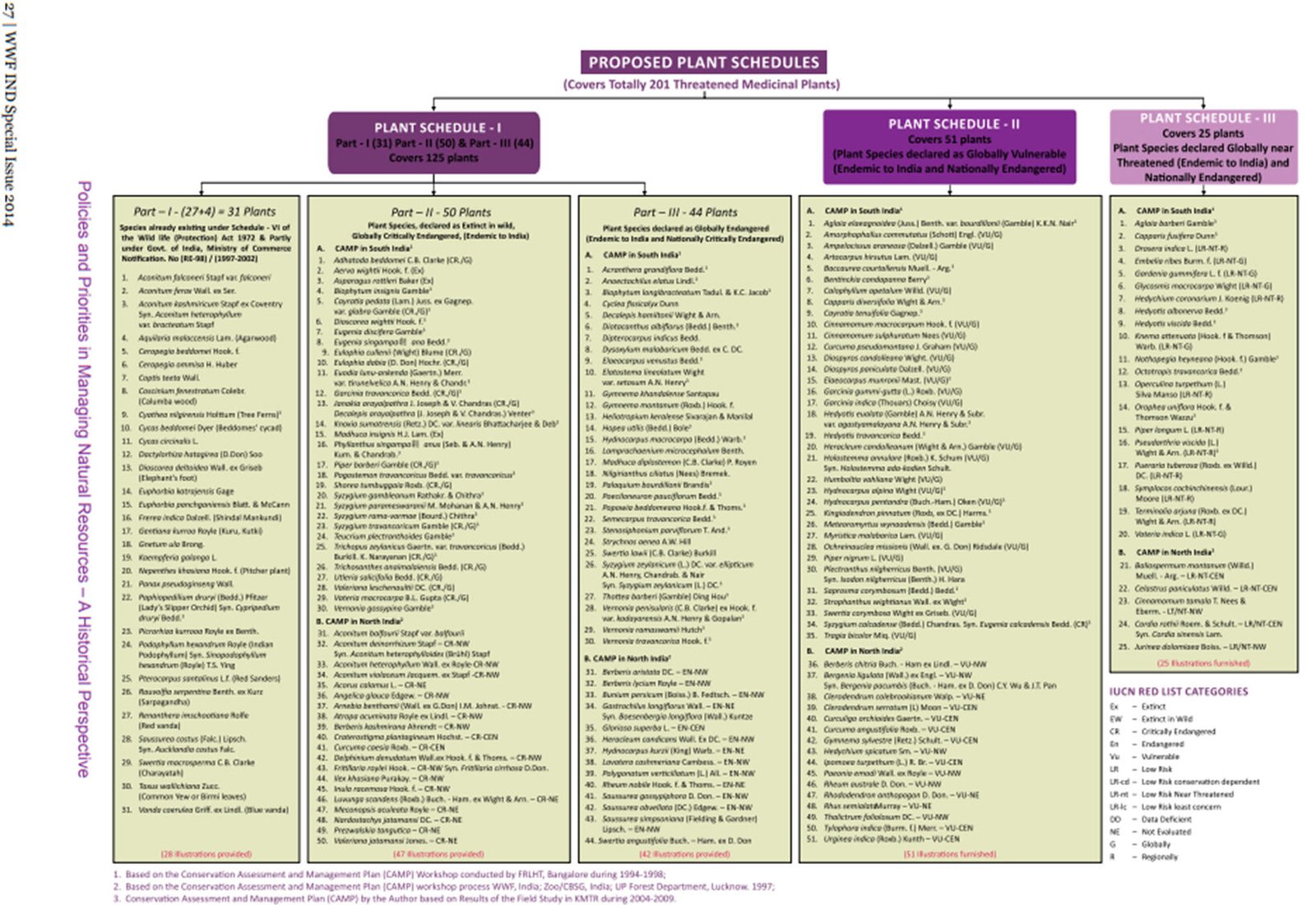
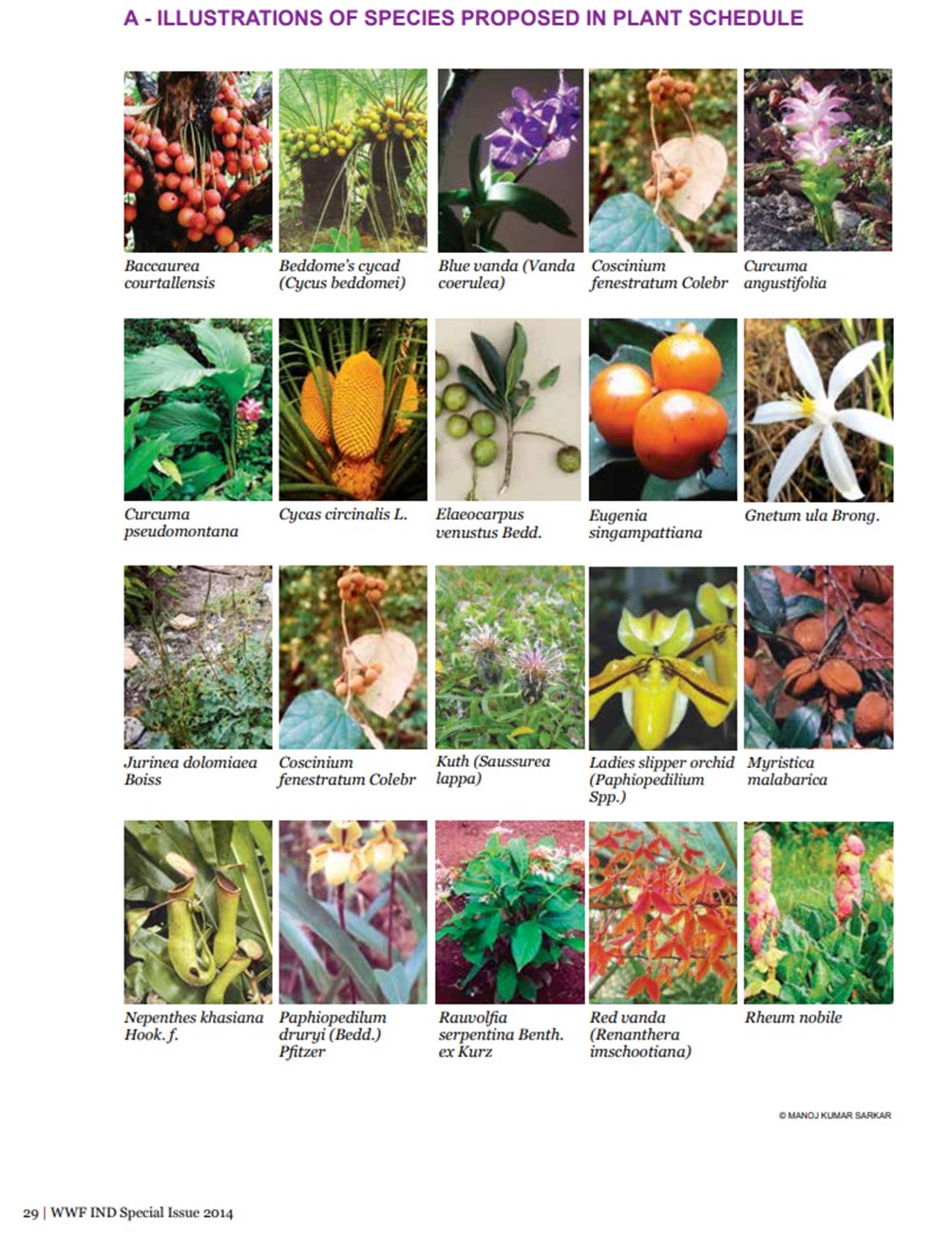
Separate schedules need to be created immediately for the imperilled plants in either the WPA, 1972 or the Biological Diversity Act, 2002 based on the list of plants already available in Schedule VI of the Wildlife (Protection) Act, the Ministry of Commerce list of notified plants, 1997 IUCN Red List of Threatened Plants and the lists of Conservation Assessment and Management Plan (CAMP) that include the threatened medicinal plants in southern and northern India (2001). This then needs to be legislated as in the case of the faunal species. Presently, it is suggested that 201 wild endemic and threatened medicinal plants be covered under three separate plant schedules.
Manoj Kumar Sarkar
He is an IFS officer of 1986 batch, currently working as Chief Conservator of Forests, Tamil Nadu Forest Department, Government of Tamil Nadu, India. Dr Sarkar did his graduation and post graduation from the Presidency College of Calcutta University and Indira Gandhi National Forest Academy, Dehra Dun and MBA in Public Policy from Indian Institute of Management, Bangalore. He was conferred a doctorate degree in Botany from Bharathidasan University, Tiruchirapalli, Tamil Nadu.
As a student and an IFS officer, Dr Sarkar conducted study on the Endemic and Threatened Medicinal Plants of India located in the world famous Kalakad Mundanthurai Tiger Reserve (KMTR).