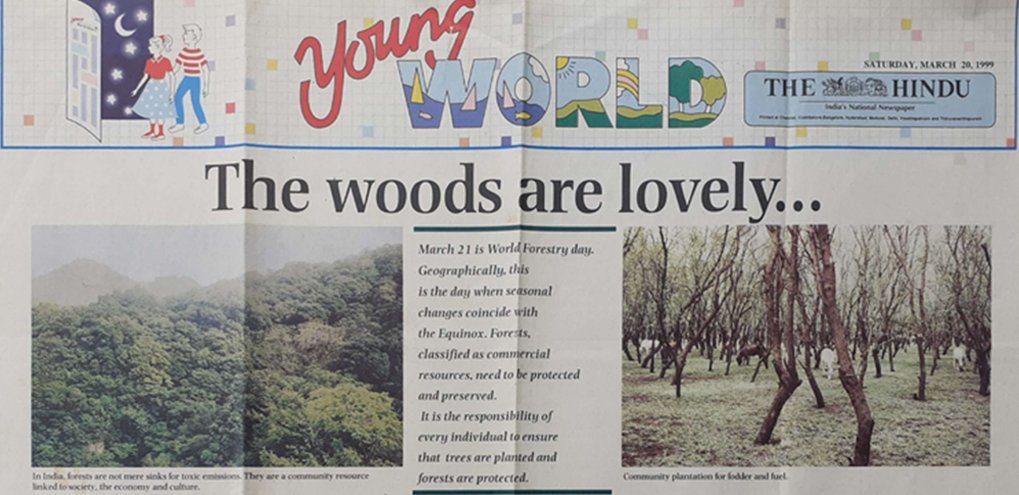




THE WOODS ARE LOVELY
(THE HINDU YOUNG WORLD)
21 MARCH, World Forestry Day, was thought of at the European Conference of Agriculture in 1971 in Spain. Consequently, the Food and Agriculture Organization (FAO) decided that it would be celebrated in every country. Geographically, this day is when seasonal changes coincide with the Equinox, the date when day and night are equal. The day is also when spring ends and summer begins. Physiologically, in the plant kingdom, this day coincides with a period of gradual increase in photo-period and the onset of active growth period of plant tissues despite the relatively dry season.
Indian civilization, at all social levels, has been impregnated with environmental consciousness, which can be traced back to the Vedic period onwards. We in India do not look upon our forests as mere sinks for toxic emissions. Forests mean much more to us, more as a community resource linked to society, the economy, and culture.
While the rich talk about the ozone layer, global warming, and forests as sinks for carbon emissions, communities around forests worry only about their day-to-day struggle for basic commodities like water, firewood, and a square meal. For a layman away from the forests, the term conservation seems to be complicated.
After independence, forests, in addition to being classified as commercial resources, were a resource that could be preserved and protected. With the changes in society, forest administration started losing its effectiveness. Several rules and regulations were passed to overhaul forest policies, yet they were not so effective from the social point of view. The preservation and protection that people could require even today were based on their social beliefs and rituals.
The natural pockets of vegetation maintained and preserved for centuries in the name of a village deity were usually looked after by the local communities. But seldom touched for any kind of produce. There are many rare species, and they are called sacred groves.
Forest management requires the cooperation of the people. Despite several attempts to preserve our biodiversity by declaring forests as protected ones, is there an example like the sacred groves maintained for several years by the local people without any incentive or directions from any agencies?
The rapid depletion of forests is attributed to the rapid population growth, but there are policies, especially the National Forest Policy: 1952, which recommends tree planting. Though such schemes are successful, people’s participation in the preservation and protection of natural forests was not stressed. In 1981, the idea was thought of in Tamil Nadu and implemented as a part of joint forest management. The concept is around the protection of forests with a mutual understanding between the forest department and the people living near these areas.
A further step was taken with a policy of people’s participation in forest management, implemented in ‘Arabari’ in West Bengal. About 20 states have launched the scheme.
The concept of pure air, pollution checks, and acid rain does not bother the common man. Unless the individual is assured of logical returns, he will not be motivated to grow trees. It is here that the idea of tree crops comes in. The generous growth of Mesquite (Prosopis juliflora) trees in the dry parts of southern India has fulfilled the household demands of the poorest of the poor. In fact, the wood cut from the forests is sold to ensure the family’s daily income. Under the joint forest management scheme, the States have liberalized the system of forest produce by providing free collection and sale of such produce. The 1988 National Forest Policy emphasizes improving the production and marketing of forest produce. If appropriate measures are initiated for this purpose, the economic returns will be good.
According to a survey done by the Ministry of Environments and Forests, over 8,000 plant species are used as medicinal plants. The estimated market value of allopathic medicines derived from plants used in traditional remedies is over $43 billion annually. When an individual realizes the necessity of planting and protecting trees, he/she will require no further motivation.