



Published inthe Science Express— NATURE – on Tuesday,June 20, 2000.
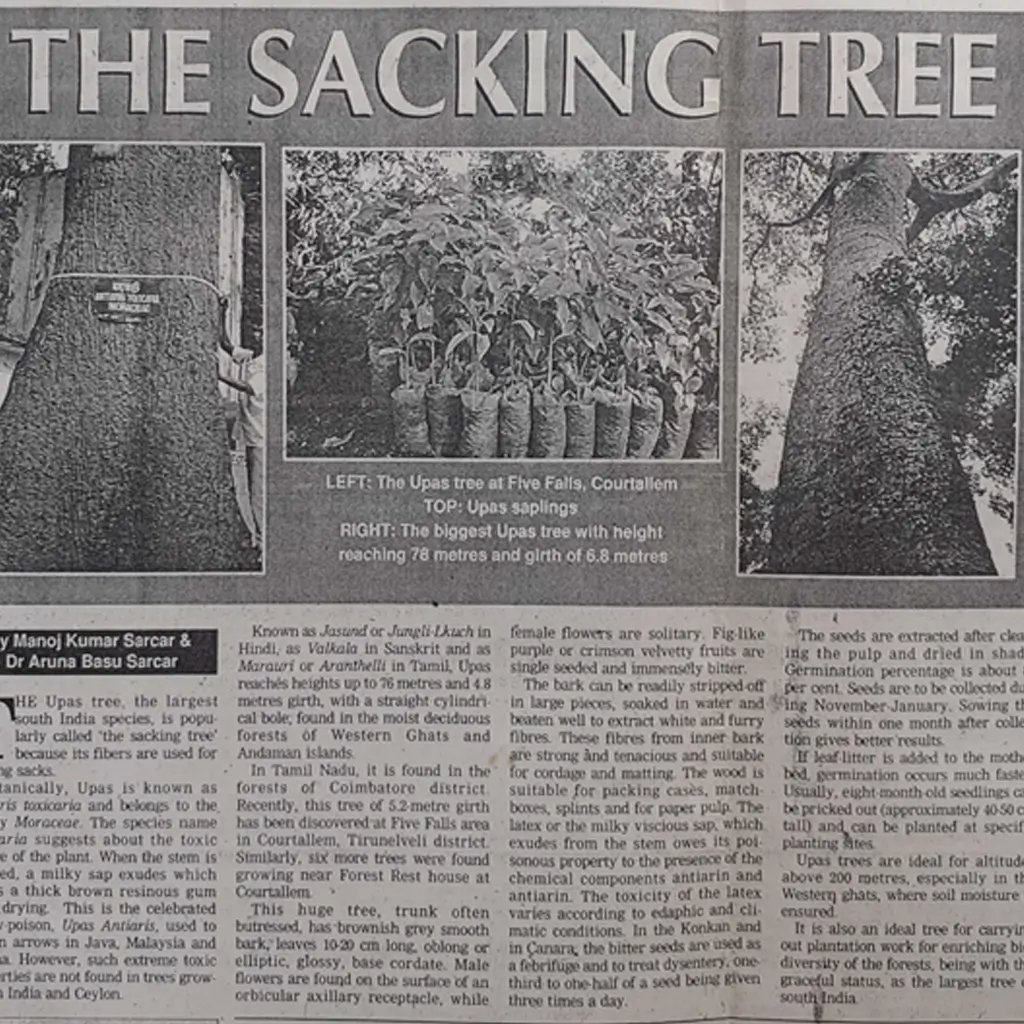
THE Upas tree, the largest south India species, is popularly called ‘the sacking tree’ because its fibbers are used for making sacks.
Botanically, Upas is known as Antiaris toxicaria and belongs to the family Moraceae. The species name toxicaria suggests about the toxic natureof the plant. When the stem is pierced, a milky sap exudes which forms a thick brown resinous gum after drying. This is the celebrated arrow-poison, Upas Antiaris, used to b poison arrows in Java, Malaysia and Burma. However, such extreme toxic el properties are not found in trees growing in India and Ceylon.
Known as Jasund or Jungli-Lkuch in Hindi, as Valkala in Sanskrit and as Maraurior Aranthelli in Tamil, Upas reaches heights up to 76 metres and 4.8 metres girth, with a straight cylindrical bole; found in the moist deciduous forests of Western Ghats and Andaman islands.
In Tamil Nadu, it is found in the forests of Coimbatore district. Recently, this tree of 5.2-metre girth has been discovered at FiveFalls area in Courtallam, Tirunelveli district. Similarly, six more trees were found growing near Forest Rest house at Courtallam.
This huge tree, trunk often buttressed, has brownish grey smooth bark, leaves 10-20 cm long, oblong or elliptic, glossy, base cordate. Male flowers are found on the surface of an orbicular axillary receptacle, whilefemale flowers are solitary. Fig-like purple or crimson velvety fruits are single seeded and immensely bitter.
The bark can be readily stripped-off in large pieces, soaked in water and beaten well to extract white and furry fibres. These fibres from inner bark are strong and tenacious and suitable for cordage and matting. The wood is suitable for packing cases, match- boxes, splints and for paper pulp. The latex or the milky vicious sap, which, exudes from the stem owes its poisonous property to the presence of the chemical components antiarin and antiarin. The toxicity of the latex varies according to edaphic and climatic conditions. In the Konkan and in Canara, the bitter seeds are used as a febrifuge and to treat dysentery, one–third to one-half of a seed being given three times a day.
The seeds are extracted after cleaning the pulp and dried in shade. Germination percentage is about 80 per cent. Seeds are to be collected during November-January. Sowing the seeds within one month after collection gives better results.
If leaf-litter is added to the mother bed, germination occurs much faster. Usually, eight-month-old seedlings can be pricked out (approximately 40-50 cm tall) and can be planted at specific planting sites.Upas trees are ideal for altitudes above 200 metres, especially in the Western Ghats, where soil moisture is ensured.It is also an ideal tree for carrying out plantation work for enriching bio- diversity of the forests, being with the graceful status, as the largest tree of south India.