



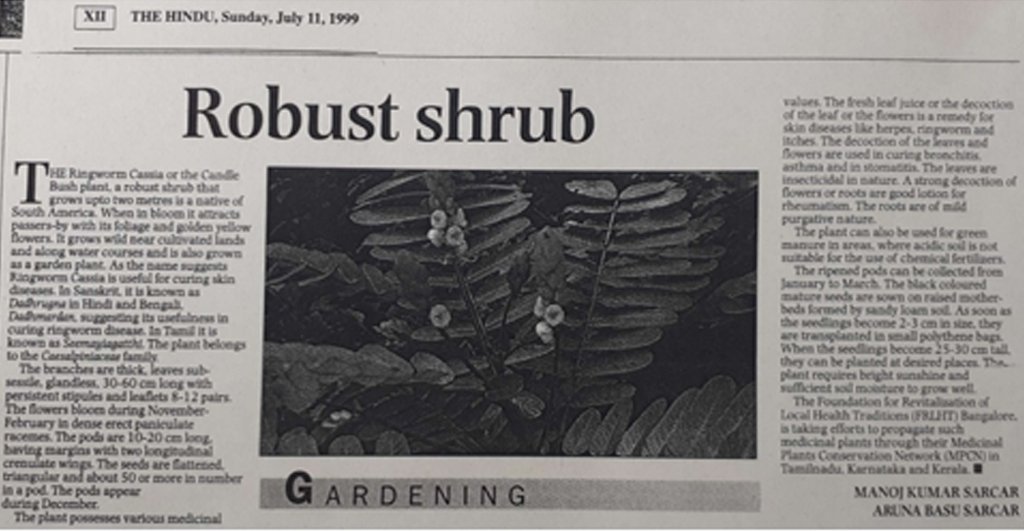
THE Ringworm Cassia or the Candle Bush plant, a robust shrub that grows upto two metres is a native of South America. When in bloom it attracts passers-by with its foliage and golden yellow flowers. It grows wild near cultivated lands and along water courses and is also grown as a garden plant. As the name suggests Ringworm Cassia is useful for curing skin diseases. In Sanskrit, it is known as Dadhrugna in Hindi and Bengali, Dadhmardan, suggesting its usefulness in curing ringworm disease. In Tamil it is known as Seemayiagatthi. The plant belongs to the Caesalpiniaceae family.
The branches are thick, leaves sub- sessile, glandless, 30-60 cm long with persistent stipules and leaflets 8-12 pairs. The flowers bloom during November-February in dense erect paniculate racemes. The pods are 10-20 cm long, having margins with two longitudinal crenulate wings. The seeds are flattened,
triangularand about 50 or more in number in a pod. The pods appear during December.
The plant possesses various medicinal values. The fresh leaf juice or the decoction of the leaf or the flowers is a remedy for skin diseases like herpes, ringworm and itches.
The decoction of the leaves and flowers are used in curing bronchitis, asthma and in stomatitis. The leaves are insecticidal in nature. A strong decoction of flowers or roots are good lotion for rheumatism. The roots are of mild purgative nature.The plant can also be used for green manure in areas, where acidic soil is not suitable for the use of chemical fertilizers.
The ripened pods can be collected from January to March. The black coloured mature seeds are sown on raised mother- beds formed by sandy loam soil as soon as the seedlings become 2-3 cm in size, they are transplanted in small polythene bags. When theseedlings become 25-30 cm tall, they can be planted at desired places. The plant requires bright sunshine and sufficient soil moisture to grow well.The Foundation for Revitalization of Local Health Traditions (FRLHT) Bangalore. is taking efforts to propagate such medicinal plants through their Medicinal Plants Conservation Network (MPCN) in Tamil Nadu, Karnataka and Kerala.