



IT has been estimated that soil loss in India due to erosion is about 12,000 million tonnes per annum. The loss of NPK (Nitrogen-Phosphorus-Potassium) is more than the country’s fertilizer output.
To prevent soil erosion and in carrying out soil and moisture conservation works at low cost, vetiver grass could be used as an ideal plant in dryland farming. Commonly called as Khas-Khas, it grows naturally in plains, lower hills, river banks and in marshy areas of Haryana, Punjab, Gujarat, Uttar Pradesh, Bihar, Assam and also in southern states.
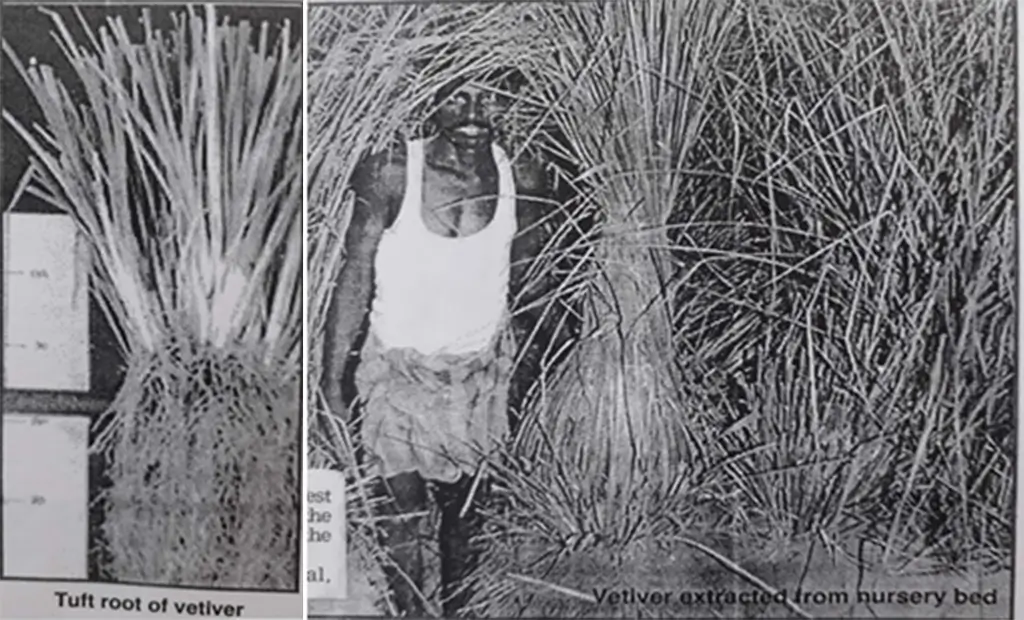
Botanically named as Vetiveria zizanioides, it is a densely tufted, perennial grass but sterile outside its natural habitat. It has no rhizomes or stolons. It is propagated by root divisions or slips.
Vetiver’s spongy root system binds the soil to a depth of up to 3 meters. By forming a dense underground curtain along the con- tour of the land, the roots prevent riling, gullying, and tunneling.
A vetiver hedge is key to the in-situ moisture conservation in rain-fed farming system. It serves as a guideline for oil ploughing and planting on the is contour and, in times of heavy er rain and storms, prevents K largescale erosion.Vetiver grows in all types of 12- soil and in a wide range of climatic conditions. Its propagation is easy. The superior cultivar should be collected to raise nursery. In Karnataka, six cultivars have been identified. One cultivar exhibits superior characteristics for hedge formation, fodder, and insect-disease and, drought-resistance.
The best nursery site can be selected in loamy sands where a drainage is good. Then slips are planted in a double or e triple line to form parallel hedges in a nursery bed. The hedge rows should be 30-40 cm apart. Application of fertilizer to the slips with diammonium phosphate (DAP, @ 150 kg/ha Nitrogen) and irrigation once in a fortnight encourages fest tillering. Dibbling of DAP into the planting furrow before planting the slips will be enough.To collect planting material, spade or fork is used to extract a vetiver clump. Then, a handful of grass, roots is torn out from the clump to form the slip which are planted in the field.
The planting of slips is done at the beginning of the wet season. Holes are made 10 to 15 cm apart in the furrow that was ploughed to make the contour. The slips are then pushed into each hole by taking care that the roots are not bent upwards. The slips are firmed by tightening the soil. The gaps formed by casualities should be filled by planting new slips. The plant must form a hedge.
To encourage tillering and hedge thickening, the grass should be cut back to 30-50 cm after first year. White ant- infestation can be controlled by applying 1 kg of BHC pow- der for every 150 m of hedge line. Established hedges are trimmed to a height of 30-50 cm annually. Vetiver hedges take about three years to be fully effective.
The initial cost of hedge establishment is estimated at Rs. 288 per 100m of hedge. The cost to produce new hedges is relatively low, about Rs. 72 per 100m, if planting material is raised in nursery. Hence, the economic returns are more than 100 per cent. For each hectare 250 meters of hedge is required.
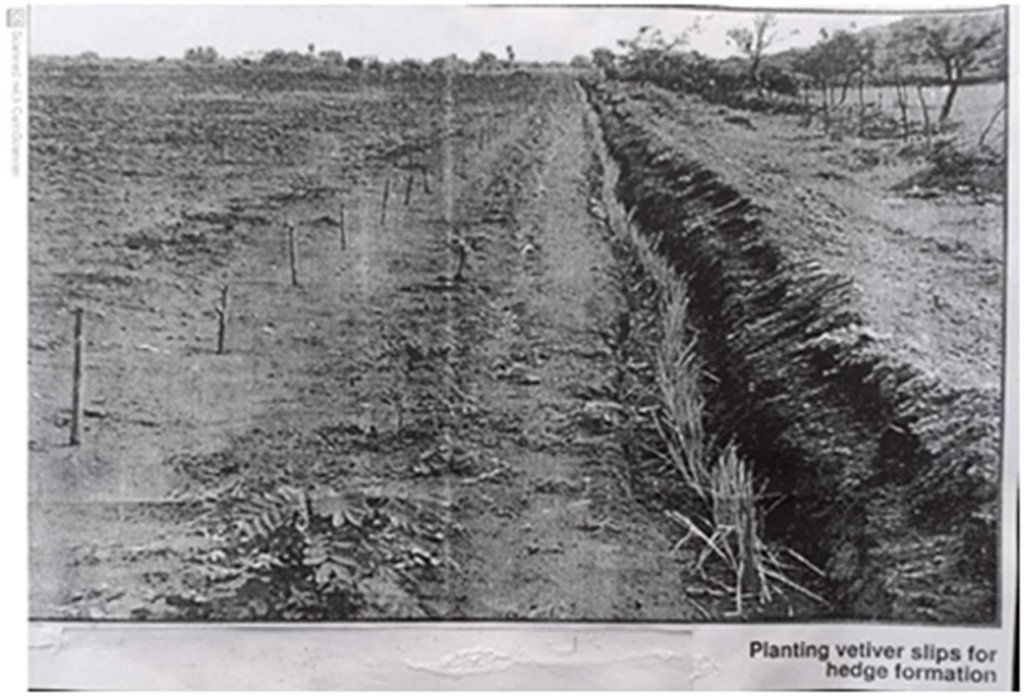
The combined effect of contour cultivation and vetiver hedge for mation do wonders even in slopy land by arresting almost total soil erosion and allowing water infiltration into sub-soil and thereby raising the ground water table in the watershed area. Some early results in alfisols and vertisols indicate that rainfall run-off was reduced from 40 per cent to 15 per cent (compared with the control) and silt loss was reduced from 25 tonnes per hectare to six tonnes per hectare (all for two-year-old hedges on 2 per cent slopes). Apart from prevent- ing soil erosion, oil extracted from vetiver’s roots is very valuable and an important raw material for the perfume industry. The roots are used for making screens (Khas Chiks) mats, handfans, baskets, etc. In dry, degraded and exposed hilly terrain, the spongy golden root systems act as a boon to the farmers, horticulturists, foresters in in-situ soil and moisture conservation at low cost and also in get- ting an additional annual income.
( The authors are IFS officers, District Forest Office Bunaglow,
High Ground Road, Palayamkottai, Tirunelveli-2 )