



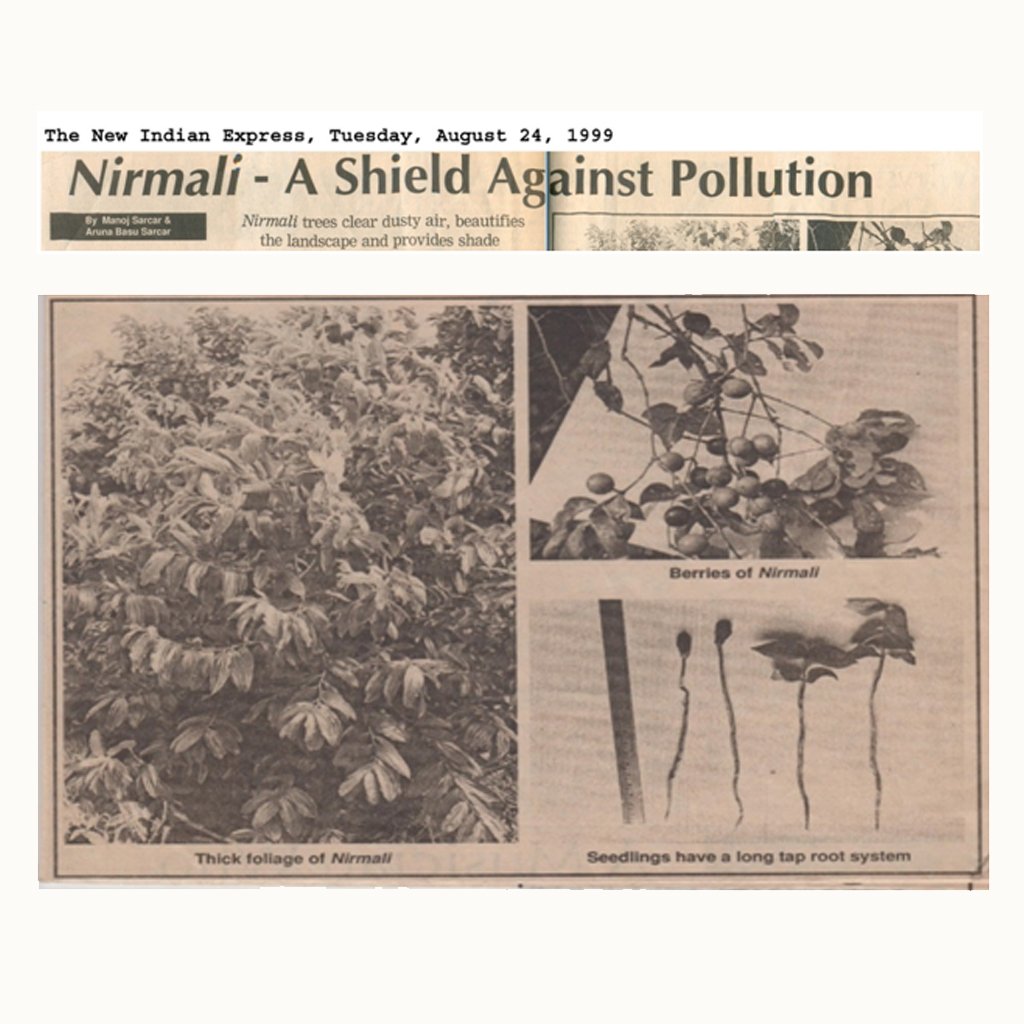
Nirmali trees clear dusty air, beautifies the landscape and provides shade to the passers –by
SCIENCE EXPRESS NATURE Tuesday, August 24, 1999
NIRMALI commonly known as the clearing nut tree, finds mention in Manu Samhita. In Ayurveda, Susruta mentions the use of its seeds forclearing muddy water in the chapterWater. According to the Charak Samhita, Nirmali is effective in curing eye diseases.
Nirmali, botanically known as Strychnospotatorum (Linn), belongs to the family Loganiaceae. Known as Kataka or Ambu prasada in Sanskrit, Nirmali in Hindi and Bengali and Tettran Kottai in Tamil, it is a tall deciduous tree growing up to a height of over 12 meters.Found abundantly in West Bengal, Central India and South India up to an altitude of 1,200 metres, the tree is very common in dry deciduous forests of the Indian peninsula.
Its bark is thick, blackish, and corky with deep vertical cracks, trunk often irregularly fluted. Leaves are elliptic, 5-12 cm long and nearly sessile, sub coriaceous, glabrous and shining. It has white fragrant flowers in auxiliary sessile cymes and fruit are berries, which are thin shelled, deep bluish black and globose.
Ripe seeds are used for clearing muddy water. It settles the colloidal matter suspended in muddy water. The water-clearing quality of the seeds is due to the presence of alkaloids. Analysis of the family powdered seeds gave following details:
Moisture 8.2 per cent, nitrogen 0.33 per cent, alkaloids 0.17, Brucine, ash 1.34, sucrose 1-2 and Loganin.
Nirmali, which has dense foliage, can be grown as an ornamental tree. It is ideal for avenue plantation and suitable for plantations near building complexes, parks and barren lands. It acts as a shelter belt against strong winds and filters dust particles.
A row of these trees at six metresespacement will serve the purpose of clearing the dusty air, beautifying the landscape and provides dense shade to the passers-by.
The tree is drought hardy and has proved to withstand severe drought. Although its wood is hard to saw, it is still suitable to make agricultural implements.
Some of the medicinal applications of Nirmali are: In case of long-standing chronic diarrhoea, which becomes resistant to other medicines, Nirmali’s seed powder (about 500 milligram) is added to cup of water and boiled till it reduces to half the quantity.
It is then filtered and taken after meals. If it is repeated for a fewdays, the ailment will be cured.
For people suffering from frequent attacks of cough, one gram of crushed fruit is soaked in hot water for 5-7 hours gives good result. The liquid should be filtered and taken at least 3 to 4 times a day.
Belching problem: It is caused due to accumulation of fat in the abdominal region. Belching can be cured with a decoction of Nirmali’s seed. Mix two grams of seeds in two cups of water and boil it till the quantity is reduced to half.
Take the decoction a couple of times with an interval of 3 to 4 hours for a few days, frequent belching will be cured.
A mixture of Nirmali’s seeds, honey and camphor is applied to the eyes in lachrymation or copious watering from eyes. Ripe fruits and seeds are used as antidotes against snake bite. (Source: ChiranjeebBanaushadhiby AyurvedacharyaShibkali Bhattacharya)
For propagation, seeds should be collected between October and March, when berries become ripe and turn black. The seeds are extracted after removing the pulp and dried in shade. Seeds are to be pre-treated by soaking the seeds in water for 48 hours before sowing them in the mother bed. Seeds germinate in a span of 35 to 45 days. If proper care is taken, one can get about 80 seedlings out of 100 seeds sown in the mother bed.
The seedlings have a long tap root system which helps it to withstand extreme drought