



SCIENCE EXPRESS, Tuesday, February 8, 2000
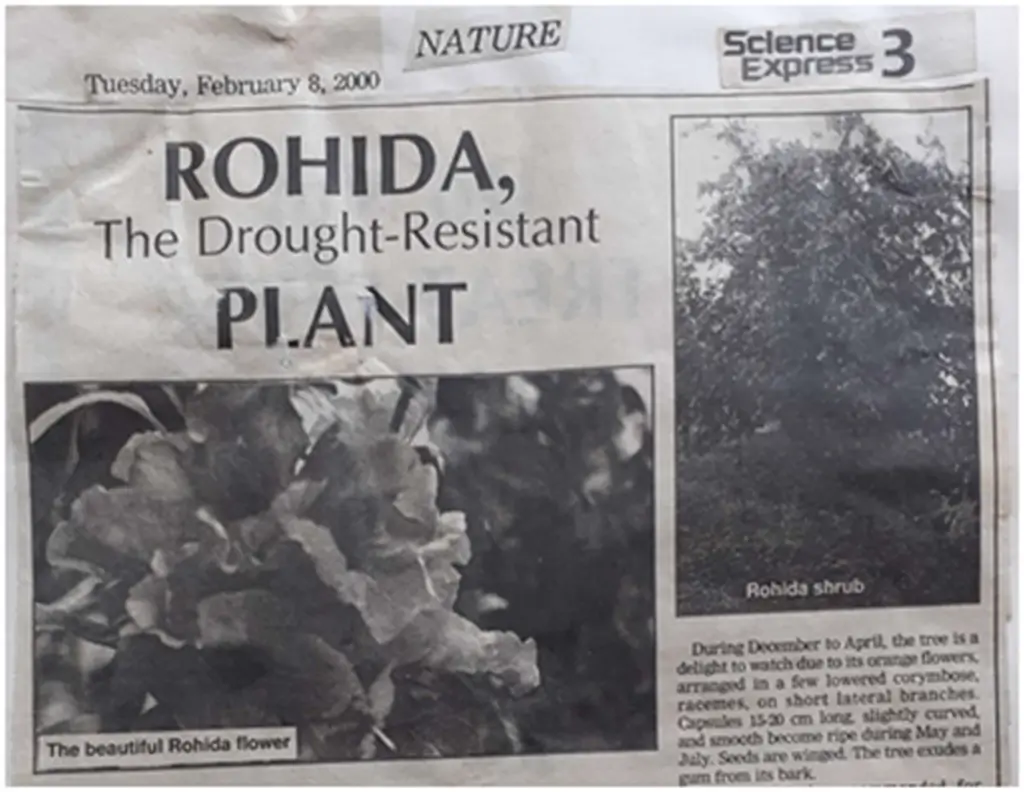
Apart from being a great survivor, Rohida’s brilliant colours make it a higly-prized ornamental shrub
ROHIDA, botanically known as Tecomellaundulata or Tecoma undulata, is a deciduous ornamental shrub. Mostly grown in gardens for its handsome pale yellow to deep orange flowers, it is called Roheda in Hindi and Kutashalmali in Sanskrit.The plant is also grown along road- sides, parks and near public buildings. It grows in dry regions of the country like Rajasthan, Punjab, Gujarat and outer Himalaya
A member of Bignoniaceae family, the plant is a large shrub with drooping branches and greyish green foliage, but when cultivated, it may grow as high as 12 metres with a girth up to 2.4 m with good foliage serving as a shade tree. Leaves are oblong or linear-oblong.
During December to April, the tree is a delight to watch due to its orange flowers, arranged in a few lowered corymbose, racemes, on short lateral branches. Capsules 15-20 cm long, slightly curved, and smooth become ripe during May and July. Seeds are winged. The tree exudes a gum from its bark.
The species is recommended for afforestation in dry areas of India, where rainfall is below 40 cm. It is an ideal species for sand dune stabilisation, both for inland area and coastal area. And forest fire-prone arid zones and rain shadow zones of Deccan peninsula. The plant is an excellent avenue tree for its graceful attractive flowers.
It can be propagated from either seeds or cuttings. In Tamil Nadu, the plant has been successfully grown in Sankarankoil (Tirunelveli district) and KudiraimozhiTheri (Tuthukudidistrict).It is fire-resistant. In north India, cattle browse it readily, but in Tamil Nadu it has been observed that it is not generally browsed by cattle.
The plant’s wood is tough, strong, and durable, mottled handsome and is highly- prized for furniture, carvings and agricultural implements. The bark of the young branches isused in the treatment of eczema and other medicinal purposes.
Dr. Aruna Basu Sarcar & Manoj Kumar Sarkar; (The authors are Forest Qfficers, District Forest Officer Bungalow No 3, High Ground Road, Palayamkottai Tirunelvelli-627002)